|
|
A Quick Introduction
As I mentioned, I was a humor columnist, or, at least
I vaguely resembled one. The column I wrote was called "Barefoot
in the Park" for various reasons, the main one being that the
publication I wrote the column for is called The Park Bench.
In any case, for a couple of years, I ran a continuing series on the
history of the world in my column. This is a work in progress, and
I'm not sure I'll ever finish the series, but it's been fun to do,
and people have told me they like it.
All of the columns are posted here as close to the
form in which they were originally printed in the Bench
except the first one, which has not been publicized until now. Enjoy.
|
|
|
|
|
Chapter 1
|
Editor's Note: Certain persons might be offended by Mr.
Hainley's column this month because he speaks about such things as
Evolution and completely ignores the possibility of Creation. Also,
he uses offensive words like "lawyer" and "spin doctor".
Okay, boys and girls. Here it is: the
long-awaited Barefoot in the Park History of the World.
Originally, the universe was created when all these
quarks and things were jammed into an area the size of my kitchen.
They were not happy. "Gee," they said, "this place is
cramped. Also, there's not even enough counter space to make a decent
sandwich. Let's create a universe or something." So someone
opened a door, and they all jumped out and started making atoms and things.
The first thing that happened was that a bunch of them
turned themselves into Physicists with stopwatches, so they could
time the whole universe-making process, and later write long and
pointless articles for Omni and Discover which never quite pan out as
entertaining information. Then for a while nothing happened. This was
because the quarks that hadn't turned themselves into physicists were
all trying to get out of the door at the same time, and having one of
those humorous log-jams like in a Three Stooges movie, but the
physicists refused to count it, because they don't really understand
that kind of humor. Then somebody lost a contact lens, and everyone
spent the next half-hour crawling around on he floor looking for it,
until one them pointed out that there weren't any contact lenses yet,
and, anyway, quarks don't have eyes. "Oh, yeah," they all
said, laughing in that good-natured way people do when they feel stupid.
Now things started happening. But none of it was
either interesting or particularly amusing—except to physicists,
who are too busy trying to come up with the money to make a new
super-collider so they can smash atoms together and find out what
happens (they break)— so we'll skip that part and jump straight
to the part where the Solar System got created when a giant gas cloud
started spinning very fast, even though his mother told him not to.
For a while, the Earth was very hot, because of all that exercise,
but, eventually, life appeared. Not life as we know it, obviously.
Just one-celled amoeboids that slimed their way across the
living-room; for example, lawyers and spin doctors.
Discussion Questions:
1) If physicists don't understand "Three
Stooges" humor, what kind of humor do they understand?
2) What's the difference between a lawyer and a
catfish? (Hint: One's a scum-sucking bottom-feeder, and the other's a fish.)
|
|
|
|
|
Chapter 2
|
Editor's note: This is part 2 in Mr. Hainley's series on the
History of the world. Some people might be offended, because he
ignores Creation theory. Also, he uses words like lawyer and PAC.
Part 1 was mostly twaddle, so we didn't bother printing it. We liked
the bit about quarks, though.
When we left off, all the life on earth consisted of
slimy one-celled animals such as paramecia and divorce lawyers. Well,
eventually, a bunch of these guys got together and decided to form
themselves into multi-celled life forms such as jellyfish and
Political Action Committees (PACs). These beings were very
disorganized and could never find their keys, so they decided that if
they wanted the really heavy federal dollars they'd have to form into
organized life-forms like lobsters and squid. Then they got to liking
this development thing, and just kept it going until they all turned
into dinosaurs (okay not all of them).
Now a common misconception about dinosaurs is that
they were all vicious, slavering predators that could finish you off
in one bite. No, indeed! As the informative nature film Jurassic
Park plainly shows, some of them had to take two, three, or
even four bites to eat a grown man.
So, the dinosaurs took a couple of million years off
of the whole evolution business and spent them bumming around the
world, which was a lot like Key West at the time, only more so. Then
they all died off. What happened to the dinosaurs? Why did they all
die off? Nobody really cares, but paleontologists believe that a huge
chunk of asteroid or comet crashed into the Earth, much like the one
that crashed into Jupiter last year prompting the following headline
in the Weekly World News: GOAT GIRL, 9, GIVES BIRTH TO DOG BOY, 15.
Discussion questions:
1. Haven't we all heard just about enough lawyer jokes?
2. If you were a dinosaur, how would you feel if
a giant meteor crashed into the earth? What if it only hit your
neighbor's cat?
3. Who writes those headlines for the Weekly
World News and what drugs, if any, is he taking?
|
|
|
|
|
Chapter 3
|
Editor's note: This is part three in Mr.
Hainley's series on the history of the world. Next time he decides to
write a series of columns, we hope he writes them for someone else.
Well, the good news is that nobody believes that human
beings evolved from monkeys. Leading scientists now believe that
humans are evolved from an animal called the Lemur, making the monkey
sort of a maiden aunt. The bad news, of course, is that the lemur is
the second most ridiculous-looking animal on earth. It's basically
what you'd get if you taped a frog's eyes on a cat (not that I'm
suggesting you should).
So these lemurs did some evolving, and eventually,
some of them, the ones that had lost their tails and that startled
look (they were more into aloof calm), decided it would be a good
idea to move out of the trees and into some caves that a friendly
real estate agent had showed them. More followed, and despite an
intense advertising campaign by the tree owners ("If you lived
in a tree, you'd be home now") everybody who was going to be
anybody was living in a cave. Many scientists believe that a large
part of the reason for the move to caves was that a cave is much less
likely to be knocked over by a woolly mammoth trying to scratch an itch.
Eventually, the ex-lemurs (who were definitely NOT
monkeys or gorillas or anything like that, we now know that anyone
who thinks they were are morons) living in the caves started getting
into all the new cave appliances: rocks, primitive spears, fire, more
rocks. Then they learned that cattle and sheep were actually pretty
stupid, so they could keep them around in case they got hungry. Then
the learned that they could make bricks from mud, straw, and cow
poop, but no one wanted to do it, so they invented slavery so some of
them would HAVE to do it even if they didn't want to.
Next they built the first city, Sumer, which was
followed by Babylon, and Ur, and a bunch of others that'll have to
wait until next time because I'm running out of room, and we have to have
DISCUSSION QUESTIONS
1) If a lemur's only the second most
ridiculous-looking animal, what's the first? (Hint: Ross Perot)
2) Did you ever wonder how some of these things
got discovered? I mean, mud, straw and cow poop? These aren't exactly
items you want lying around in the garage...
3) Could you write a swinging song about Ur like
"New York, New York"?
|
|
|
|
|
Chapter 4
|
—EDITOR'S NOTE: Can you believe he's still
going with this thing? Talk about running a joke into the ground!
Next time he pitches an idea to us, we're really going to make an
honest attempt to stay awake all the way through instead of just
nodding and saying "Great idea!" every time he pauses.—
Last month, if you remember, a bunch of people got
together and invented civilization. To do this, they went to "The
Cradle of Civilization", which was in the desert. This seemed
like a pretty good idea at the time, but, of course, they'd just
invented beer, so lots of ideas had seemed pretty good. After a
while, the Sumerians were over-run by a band of roving artists. They
would break into people's houses, and demand that the Sumerians buy
their art. Unfortunately, these artists had giant stone lions, like
the ones on the steps of the Central Park Library in New York, and
eventually, the entire civilization was crushed under the weight of
their knickknacks.
But this was okay, because other civilizations had
started up in places like Cush (in modern-day Ethiopia), Egypt (led
by their king, Yul Brynner), Cellophane, and Cafe Ole. Also, there
were huge barbarian tribes wandering around, such as the Caucasians,
who were, even then, working on a primitive form of middle-class
guilt. In Europe, some shepherds were getting together to start Greece.
The Greeks were a very significant culture because
they were the first culture to consider table-cloths to be high
fashion. They also developed the beginnings of modern theatre,
western philosophy, and a nifty little drink called Ouzo, which
tastes as bad as it sounds, but can get you drunk just by saying its
name. Try it, "ouzo". See? Feel better all ready, don't you?
But even the Greeks would soon be overshadowed by a
new rising star on the horizon of cultural fame. I'm referring, of
course, to the
Discussion Questions
1. Have you ever done anything that seemed like a
great idea when you were tanked on beer, but turned out to be pretty
stupid, after all? Be honest.
2. Which was your favorite plague? Explain.
3. Have you ever read Œdipus? What about The
Iliad? The Odyssey?
You think you're really smart, don't you?
|
|
|
|
|
Chapter 5
|
Editor's note: This is the fifth installment in Mr.
Hainley's History of the World. Since it's sweeps month, he's
"spiced it up" by including lots of sex and other things of puerile
interest. Quite frankly, we found it shocking and disgusting. (Okay,
maybe not as bad as Melrose Place, but they certainly wouldn't put it
on PBS.)
Possibly the greatest of the ancient civilizations was
the Roman Empire. Despite the alarming fact that they often wore
salad greens as hats, they quickly became the world leaders in such
areas as the arts, literature, and government.
Not that they really wanted to be world leaders or
anything. They basically just wanted to find out what the Vegas line
was on the next event at the Colisseum, but every time the Romans sat
down with the sports page, their wives would come in from the kitchen
and say something like, "You know the Greeks invented classical
theater AND philosophy. What are you doing to improve the human
condition?" After a few months of this, the Romans would get
together with their leader, Julius "Julie the Salad"
Caesar, and placing a quick green salad on their heads so they
wouldn't forget lunch, they conquered the country that was giving
their wives a new excuse to nag.
After a while, their wives stopped complaining about
how uncultured their husbands were, and started whining that they
were never home because they always spent their time out with the
boys conquering somebody. So, the Romans stayed home, and invented
distilled alcohol, which probably led to their decision to start
using Christians as lion food.
At its height, the Roman Empire spread from England in
the west to Russia in the east, from Germany in the north to Egypt
and Ethiopia in the south, but even this great empire had to come to
an end. Eventually, the Romans were overrun by swarms of barbarians.
In wave after wave, the Visigoths, Vandals, Crips, Bloods, and New
York Mets bludgeoned their way through the Roman bar scene, causing
fights and setting the stage for
Discussion Questions
1. Conjugate the following words in Latin: Salad,
Vegas line, Visigoth.
2. Who was the last New York Met to be arrested for
getting beat up at a Houston bar? (Hint: Rhymes with Drawberry.)
3. Which was longer and more pretentious: Ben Hur
or Spartacus?
|
|
|
|
|
Chapter 6
|
Editor's note—Aah, never mind.
The Dark Ages were a serious drag for everyone involved because
basically human civilization collapsed and sank to the lowest level
possible without actually electing shellfish to political office. To
be honest, only Europe suffered in the Dark Ages. China established a
vast empire that still exists today. The Middle East was undergoing a
period of religious and philosophical enlightenment, and Africa and
the Americas saw the rise of fabulously wealthy and industrious
civilizations, including the Mayans, who developed the calendar and a
primitive form of full-contact volleyball. Unfortunately, the
chronicler is a product of America's fine, if Eurocentric, school
system, so the most non-European history you'll see here is probably
in the above paragraph.
As we were saying, the Dark Ages were a serious drag for everyone who
lived in Europe. For one thing, the protective blanket of the Roman
Empire was gone, which meant that every two-bit barbarian horde with
delusions of grandeur was free to burst in on horseback (or in
longboats, depending on tribe and religious preference), and destroy
entire towns, or, in the case of Atilla the Hun, continents. Another
problem was the amazing number of people living in Europe who weren't
Catholics. Originally, this was thought only to be a problem to the
Catholics, but as the Jews, the Celts and the Moors were to find out,
it was really everybody's problem.
Actually, now that I think of it, there's no way to be really funny
about the Dark Ages without also being extremely tacky, so, I think
it best to just skip to the
Discussion Questions
1) Other than China, can you name another Oriental Empire that was
established during the dark ages and still exists today? (Hint: Sony Corp.)
2) Would modern volleyball be more popular as a spectator sport if
beheadings were allowed? Explain.
3) Whatever happened to the Huns? You never hear about them any more.
|
|
|
|
|
Chapter 7
|
Editor's note—I'm the new editor. Just popped in to say
"hi." Hi.
The Middles ages were, if anything, more depressing than the the dark
ages before them. For one thing, the feudal (pronounced
"stupid") system had been developed to nearly a science.
The feudal system was composed largely of "knights" who
rode around on "horses" and had "jousts" when
they weren't hacking various "limbs" off of the populace
for no apparent "reason". The reasons the populace put up
with this were that a) everyone believed firmly in the Divine Right
of Kings, and b) the knights had most of the weapons and spent most
of their time covered in sheet metal, which made debate difficult in
the sense that it's hard to collect one's thoughts when a guy in
sheet metal is hacking your limbs off. Other problems were the
plagues, which killed lots of people, and the fact that hygiene was
not a high priority.
The one thing the Middle Ages did have going for them was literature.
This took the form of Geoffrey Chaucer, who was actually the Lenny
Bruce of his day, but to prevent having his arms hacked off by the
Moral Majority, he wrote all his dirty jokes in code. Also high on
the literature list was Miguel Cervantes, who spent a lot of time
being excommunicated, for no reason better than that he called the
Pope—well, we won't go into that (this is a family newsletter).
The other good thing about the Middle Ages was the rise of the middle
class, who exercised their growing power by drinking beer and
organizing softball leagues.
All this literature and middle-classing led to the creation of a
Renaissance. One day, some Italians were hanging around after a
softball game, drinking beer, and one of them said, "Hey, lets
have a Renaissance!" But all his friends said, "Let's do
that next month. This month, we'd rather have discussion questions."
Discussion Questions
1) In "The CPA's Tale" in The Canterbury Tales, remember
the joke where the Moss-Covered Rock says "Whan that Aprille
hath bathed ev'ry fleure with pilgrimages eek breethe"? Did you
get it? Neither did we.
2) If the Renaissance started in Italy, why does it have a French name?
3) Which is better, a Count a Duke or a Baron? (Hint: Who cares?)
|
|
|
|
|
Chapter 8
|
Editor's note—This month we will begin printing, in serial
form, the Barefoot in the Park History of the World—wait a
minute, didn't I already say this?
In the latter half of the 15th century, at noon on a Tuedsay, the
Italians of Milan and Venice decided to have a Rennaissance. Spurred
on by the return of Marco Polo, they decided to make a lot of money
by trading with the east, especially in Venice, where they had formed
a thriving industry in window coverings. Their salesmen would go to
China and convince them to buy these "Venetian blinds"
which opened with a simple pull of a cord, unless they were twisted
or bent which always happened. Also, they required special
accessories just to clean the huge mountains of dust off of them.
Milan had a monopoly on the "malomar", a chocolate and
marshmallow cookie that had a special chemical in it that prevented
anyone from eating only one. In Japan, some guys ate a whole shipload
of them, then started fighting over the last one in the box, and
that's how Sumo wrestling began.
The Venetians and the Milan-people used the trading income to finance
great artists like Raphael, Michaelangelo, and Leonardo da Vinci.
They hired these guys to paint and sculpt marvelous religious
masterpieces to draw attention away from the fact that many of the
"patrons" were as crazy as bedbugs. They'd kill an entire
village, and, when they went to confession, their penance would be to
have Michaelangelo paint the ceiling of the Sistine Chapel.
Meanwhile, in Spain, the Catalans were driving off the last of the
invading Moors. Early French artists were developing a primitive form
of patronizing sneer, and English King Henry the Eighth was setting
world records in the category of marriage that wouldn't be broken
until the coming of Elizabeth Taylor. But the times were soon to
change, because the fondue pot of civil unrest was overboiling from
the heat of royal excesses, leading us to wonder how far you can take
a bad metaphor.
Discussion Questions
1) Do you have Venetian blinds? Don't you secretly hate them?
2) Did you know that Warren Beatty is Shirley Maclaine's brother? Explain.
|
|
|
|
|
Chapter 9
|
Editor's Note—I claim this land for Spain and
name it India, no, wait, I name it New Spain, or maybe Bob.
The Age of Discovery ranks for wild inaccuracy right
next to World War One's alternate title of The War to End All Wars.
The Irish and the Norwegians had been fishing near Canada for
centuries, and there were tales in Africa of a land to the west. In
any case, there were already people living in the Americas, so
discovery was pretty much out of the question. Also, all this went on
during the Renaissance, so it wasn't so much an Age as it was a
chapter, or maybe a footnote1. The discovery thing started
because Europe needed a better route to the Far East. The current
route involved buying everything from Italy, which had become a lot
like the Galleria, except Italy didn't offer year-round ice skating.
So everybody headed off to the sea to find a new route to China and
India. Several great men drowned in the fickle waves of the
storm-tossed Atlantic. Then they decided that it would probably be a
good idea to use boats if they were going to sea, and that worked a
whole lot better.
The first country out was Portugal. They came back in
a rush, saying that they'd discovered Africa, but were disappointed
when all the other countries said they already knew about Africa,
since that's where Egypt was. So the Portugese went into a snit, and
decided to become a fourth-rate power.
Next came the courageous Spanish, who discovered Cuba,
and called it India; discovered South America, and called it Terra
Firma (hard ground), and discovered Mexico and called it New Spain.
Unfortunately, there were already millions of people living in the
Americas. But the courageous Spanish didn't mind, and using
diplomatic skills usually only found in a Clint Eastwood movie,
destroyed several large civilizations and some small tribes.
Discussion Questions
1) Can you identify Portugal on a map? Why would
you want to?
2) If you were an Aztec, would you rather be
murdered by Cortez or sacrificed to Quetzlcoatl?
__________
1America was discovered.
|
|
|
|
|
Chapter 10
|
Editor's note: There is no editor's note. You know,
I'm not your mother. I don't have to write a note every month.
Last month, America was discovered, which as you
recall, came as quite a shock to the Native Americans who were
already living here. Now we will be following a long-standing
tradition and ignore everyone else -- except for the English
colonies. This is because we are a good American and we were taught
in school that if it didn't happen here, it didn't happen.
The first English colonists were lured here by tales
of easily-won gold on the Spanish Main. Unfortunately, they landed in
North Carolina, missing the Spanish Main by some 2000 miles and
promptly disappeared, leaving only the mysterious message "Gone
Fishin'". Shortly thereafter, the Jamestown colony was started
and immediately began the great colonial tradition of starving to
death until Captain John Smith took the colonists in hand. Using
rigid military discipline, he turned the entire colony around. When
they turned around, they saw a deer. They killed it, and they ate it.
It was good.
Now that the colony was no longer starving, John Smith
decided to go exploring. "I think I'll go exploring," he
said, "Maybe if I'm lucky, I'll meet a young Indian princess and
an anthropomorphic raccoon, and in 400 years, a well-known movie
studio can make a film completely misrepresenting my life."
Meanwhile, back in England, the Separatists were
struggling under the yoke of religious oppression. They needed to go
to a land of freedom, a land of liberty, a land where they could burn
witches without anybody stopping them. They tried Holland, but didn't
like the windmills and so they looked west to America. A new land,
unsullied by the monarchies, where a man could stand up proud and
say, "Would you like fries with that?"
Discussion questions:
1) If you were writing a book about a bold new era
and a brave new world, would you name the hero "John Smith"?
Neither would we.
2) Describe in 50 words or less the University of
North Carolina fight song.
3) If you were burned as a witch, would you prefer
it with fries or a baked potato?
|
|
|
|
|
Chapter 11
|
Editor's Note—He's at it again.
|
When we left off, the Virginia colony had been
established on the firm concept of starvation, and the Pilgrims had
moved to Holland to escape religious persecution in the form of other
people having a different religion. But the Pilgrims didn't like
Holland. For one thing, everyone there spoke better English than they
did, plus they kept calling Holland "The Netherlands", even
though the people were called the "Dutch". So the Pilgrims
got permission to come to America.
Now, originally, the Pilgrims were supposed to land at
the Virginia colony, but due to a navigational error involving a
large sack of money, they went to Massachusetts instead. There,
obeying what had now become a law for English colonies, they started
starving until a Native American named Squanto showed them how to
make Boston Baked Beans. Squanto and his tribe, the Mohegans
(Iriquois for "Red Sox") also showed the Pilgrims how to
plant corn, hunt deer, and give incomprehensible directions.
Meanwhile, other colonies were popping up in other
places, some smack-dab on top of colonies belonging to other
countries. For instance, New York (real name: New Amsterdam)
originally belonged to Holland, but when the Duke of York showed up
in the harbor with the British Royal Navy, the Dutch, showing the
kind of fortitude usually associated with Belgium, immediately
surrendered New York, New Jersey, Portugal, and most of the Moon.
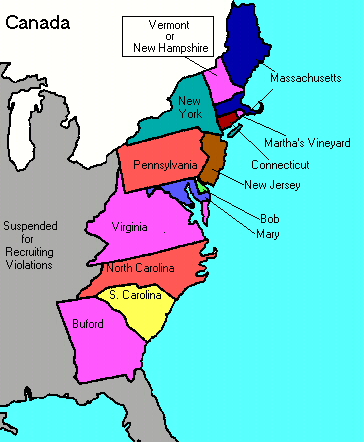
But, after a while, things settled down to the thirteen original
colonies shown here. |
 |
Discussion Questions:
1. Don't you think that guys who insist on going
"Dutch" on dates because they "respect women's
rights" are really just cheap?
2. If you managed the Red Sox, would you have
traded Ruth? Neither would we.
|
|
|
|
|
Chapter 12
|
Editor's Note—I never thought I'd be writing a
letter like this, but one day, as I was getting into an elevator this
girl with huge...Oops! Wrong note...Um, here's the next installment
of the Barefoot History of the World...
Once the colonies had settled on the correct number,
they decided to enter a period of relative peace known as The Period
That History Books Ignore Because It Was Boring. This is because it
was very peaceful and everyone was very happy, except for the slaves,
who were, well, treated like slaves, which was a drag.
Luckily, at about this time, Europe had started The
Era of Pointless Wars With Comical Names. A lot of these wars had the
word "succession" in the title, such as the War for Spanish
Succession. Others were named after monarchs for no particular
reason, such as Queen Anne's War. Still others had descriptive names,
such as The War Because the King of England Suspects That the King of
France Cheats at Monopoly. Anyway, they fought all these wars because
all the countries had huge armies built on misleading recruiting
commercials that showed soldiers leaving the army with valuable job
skills, such as King, when, in fact, most of them just slogged
through the mud.
Meanwhile, the colonies were getting bored. They'd
tried to add some spice to their lives by having the Salem Witch
Hunts (started by a young Jesse Helms), but it wasn't working out, so
they made a reservation for the next war, which was the French and
Indian war, although the Europeans called it The War Because the
French Are Always Correcting Our Pronunciation.
The French and Indian War started when a young British
Army officer named George Washington was sent to tell some French
troops to move their fort off of English land. The French refused,
and laughed at the English soldiers' comical uniforms, which so
enraged Washington that he immediately surrendered.
Unfortunately for the French, that was their only real
victory, because they immediately entered into the battle styles that
earned them their national motto, "Plus Ca Change, Plus Ca
Mem Chose" ("We Fight Like Girls").
But even as the smoke of the French and Indian war was
settling, the coffee pot of domestic tension was boiling over into
the ham and eggs of colonial tranquility, causing the, um bacon of
independence to sizzle on the frying pan of war. I think.
Discussion Questions
1. Did you ever use a metaphor that started out
pretty good, but just didn't seem to get anywhere?
2. Have you ever been to France? Disappointing,
wasn't it?
|
|
|
|
|
Chapter 13
|
I know what you're thinking. You're thinking, "How
can he possibly have something to say about the American Revolution
that's both funny, and hasn't been said a zillion times before?"
And you're right. The only funny comment that comes immediately to my
mind is that all the heroes of the revolution dressed like the
Artist-Formerly-Known-as-Prince. In fact, one of the great debates of
the Constitution was whether to name the fledgling nation The Country
Formerly Known as Prince, or to go with Ben Franklin's idea of Grand
Slam Breakfast With Extra Toast. This seemingly irreconcilable
argument was solved when the President Formerly Known as George
Washington suggested The United States of America. "We can call
ourselves Americans," he said, "and that way we can offend
the inhabitants of two continents without even meaning to."
Anyway, my point is, I'm not going too deep into the
revolution, because it's been done, and a whole lot better than you'd
find it here. If you're interested in the American Revolution (or at
least in making fun of it) I suggest you get a copy of Dave Barry
Slept Here, or any college history book with a title like The
National Experience or In the Course of Human Events,
which contain sentences like this: "Howe thus remained the
gentleman in the field; he pursued his mistress [Mrs
"Smith"] with fervor [a kind of weasel, like a ferret], but
he showed no interest in gaining a reputation as one of the horsemen
of the apocalypse." Isn't that a hoot?
So, after the revolution, the Founding Fathers got
together and decided to form a government. Unfortunately, they got
together at Samuel Adams' house, and he had a lot of beer in the
fridge, so what they ended up with was The Articles of Confederation,
which was a total failure as a governmental system, but which, when
you take out every fifth consonant and read it backwards, spells out
the joke about the guy and the duck. Also, they made Thomas Jefferson
do silly things in the portraits, such as being the only barefoot
one, spawning a cult of serious Founding Fathers Fans (defined as
people without lives) who believed that "Tom is Dead."
Obviously, there was a need for change, a need for
Discussion Questions:
1) If you could have a reputation as one of the
horsemen of the apocalypse, which one would it be?
2) Do you subscribe to any silly and unprovable
conspiracy theories? Explain.
|
|
|
|
|
Chapter 14
|
As I mentioned in last month's column, the Articles of
Confederation turned out a lot like the reunion tour of KISS, by
which I mean it's probably very entertaining, but you wouldn't want
to run a country with it. So, the Fathers of Our Country decided to
hold a Constitutional Convention. Unfortunately, not much got
accomplished, because the delegates from Virginia threatened to walk
out and there were several disruptive protests outside the whole
time. No, wait, that's the 1992 Republican Convention I'm thinking
of. I had the wrong notes out...
Here we go. The truth is, the Fathers of Our Country
weren't trying to change the government at all. In fact, the whole
constitution thing was just an excuse to get the Fathers of Our
Country out of the house without the Mothers of Our Country getting
mad. They'd be sneaking out, and their wives would say something
like, "I hope you're not sneaking out to drink beer with that
Samuel Adams," and the Fathers' would all answer, "No, I've
got to go help, um, frame a new form of government that'll be the
basis for new democracies for the next two hundred years. Sam Adams
isn't even invited."
Then, as a prank, George Washington actually made up a
Constitution, and, this is the funny part, everyone went home and
actually got their states to ratify it! Of course they had to revise
the original a bit. For instance, they changed the part that said the
President would be chosen based on who could belch the song
"Yankee Doodle" loudest, and they completely deleted the
bit about having a mandatory death penalty for wearing multicolored
wigs at sporting events. But overall, people went for it, even the
part about paying people money to go to Washington, a city which
hadn't even been founded yet.
But not everyone was satisfied with the new
government. Women, blacks, and Native Americans were all completely
forgotten. This was especially distressing to the Native Americans
who had, technically, been here first, but, since the new government
didn't give them any voice (as opposed to the old government, which
didn't give them any voice), the Founding Fathers weren't much
worried. But they were soon to change their tune when they came to
Discussion Questions:
1) Isn't it kind of annoying that '70's rock bands
are getting back together and announcing reunion tours as if we'd all
been putting our lives on hold until they did? I mean, who cares?
|
|
|
|
|
Chapter 15
|
Now that the new nation had a Constitution, the
Fathers of Our Country decided that maybe they should add some basic
rights to it, in the form of the Bill of Rights. This is considered
the second most important document in American History, because it
sets down all of our major rights so the ACLU can make ludicrous
claims such as convicted felons have the right to have a TV in their
cell as if they were staying at the Ramada Inn or something. And I
mean cable, not just local stuff. So here it is:
The 1st Amendment states that if you
want to embarrass yourself and your family by going on Jenny Jones
and acting like a total dweeb, or by shaving your head and bugging
people in airports, then go ahead.
The 2nd Amendment says that people
can horde guns. It also defines paint-ball games as "gang activity."
The 3rd Amendment says that you don't
have to let a soldier sleep over at your house unless you really,
really like him.
The 4th Amendment states that the
government can't rifle through your stuff without a good reason. But
your parents can. So there.
The 5th Amendment says that you don't
have to testify against yourself in court, but if you say, "I
plead the fifth," everyone will know you're as guilty as sin.
The 6th Amendment was kinda long, so
I skipped it.
The 7th Amendment says that if there
are runners on first and second, and fewer than two outs, and a fly
ball that is hit to the infield is a routine catch, then the batter
is out.
The 8th Amendment states thou shalt
not steal. No, wait, that's the eighth commandment. The eighth
amendment says that no one can receive cruel and unusual punishment
unless they're into that kind of thing.
The 9th Amendment defines street
basketball, or any activity where teenagers might gather in groups of
more than, say, one (including public school), as "gang activity."
The 10th Amendment is actually a
reworded copy of the ninth amendment, because they couldn't actually
think of ten things at the time, but ten seemed like such a nice,
round number.
Discussion Questions:
1) If someone offered you $500 to go on national TV
and embarrass yourself, would you do it? What if you knew that you
would get cretin letters of support written in crayon?
2) Define the following: Dweeb, Cretin, Adultery.
|
|
|
|
|
Chapter 16
|
The success of the American Revolution served as a
beacon of hope for France, which had been suffering under the yoke of
Louis MXCVI ("Revenge of the Broccoli People") and his wife
Marie Antoinette. For years the King and Queen had mismanaged the
country into the ground, all the while promising middle-class tax
cuts which, when you read the fine print, actually turned out to be
tax increases. Also, Queen Marie was constantly under investigation
for selling plots of land which didn't technically exist. One day,
when told that her husbands policies had destroyed their national
economy, and that people were starving in the streets because they
couldn't even afford bread, Marie said, "So what?"
This so enraged the French people that on July 14th,
they formed a mob and broke into the country's largest prison. A few
days later, someone suggested that maybe this wasn't such a hot idea,
so they broke back out of the prison, and attacked the King's palace
at Versailles. Before they got there, however, the king had made good
his escape. They caught him later, dressed as a woman, and executed
him for impersonating Uncle Miltie.
Now that the monarchy in France had been destroyed,
the French needed a new form of government, so, using the kind of
decision-making skills that has made France famous, they created a
"Revolutionary Council" composed of a bunch of nutcases,
and one guy who--and I'm being completely serious here--had a medical
condition which required that he spend upwards of 8 hours a day in a
nice warm bath. The Revolutionary Council, following France's new
motto of "liberté, egalité,
fraternité," decided that the best way to prevent another
abusive monarchy was to kill off the entire population. They also
invented the metric system which tells you how crazy they were.
In five years they managed to do more damage to France
than the monarch had in a thousand. Luckily, Robespierre, the
President of the Council, accidentally put his name on the list of
those to be executed one day. "Ce la vie," he was heard to
say. Or maybe it was "Oops." Once again, Paris was plunged
into turmoil. Anyone could clearly see that a leader was needed, a
tactical and governmental genius, a man whose very name would haunt
short people for the rest of history: Woody Allen. Unfortunately, he
wouldn't be born for several years, so they settled on Napolean Bonaparte.
Discussion Questions:
1. If you were in love with a woman who was in love
with a guy who looked exactly like you, except he was a weenie, would
you take the other guy's place on death row like the hero in A Tale
of Two Cities did? Neither would we.
2. Do you ever get the willies when you see Milton
Berle in drag? What about Bea Arthur?
FUN CLASS PROJECT: Build your own
Guillotine! Get some wood and a piece of sheet metal. Now, fit tab
"A" into slot "B" while being sure to keep blade
"C" from cutting off your hand. All done! Go take a nice
warm bath!
|
|
|
|
|
|
Answers to Discussion Questions
|
Chapter 1
|
1 |
Gary Larson's The Far Side |
|
2 |
A catfish is much less likely to sue me over that joke. |
|
|
Chapter 2
|
1 |
No. |
|
2 |
That would be bad. Well that's all right, then. |
|
3 |
Passing tourists and it varies. |
|
|
Chapter 3
|
1 |
Former Attorney General Janet Reno |
|
2 |
Never wondered, but if I had to guess I'd say Fraternity Dares and
Bar Bets played a huge roll. |
|
3 |
Not without a lot of Tequila. |
|
|
Chapter 4
|
1 |
Read my autobiography to find out (Available from Vaporware Books:
all thirty volumes only $2,789.99 US). |
|
2 |
Locusts. Mmmm ...locusts... |
|
3 |
Yes. Yes. Yes. Smart enough that I don't have to
look at an answer key. |
|
|
Chapter 5
|
1 |
Pffssshh...yeah. I'll get right on that. |
|
2 |
[Answer removed by Court Order] |
|
3 |
No need to argue, they were both long and pretentious. |
|
|
Chapter 6
|
1 |
Walt Disney Enterprises |
|
2 |
Well, yeah...duh... |
|
3 |
They moved to a condo complex in West Palm Beach Florida. |
|
|
Chapter 7
|
1 |
A full breakdown of Medieval Dirty Jokes can be found in my book A
Full Breakdown of Medieval Dirty Jokes (available from Vaporware
Books—only 7 Trillion Lira) |
|
2 |
Because Italian names sound funny and are never taken seriously. |
|
3 |
Zzzzzzzzzzz.... |
|
|
Chapter 8
|
1 |
Yes. Not secretly. |
|
2 |
No, I didn't, but that explains a lot. |
|
|
Chapter 9
|
1 |
It's the skinny one next to Spain. So I could get extra credit
in History class. |
|
2 |
Sacrificed, definitely...what? Not now! Get Back! AAAAAIIIIIIGGGHHH!!!! |
|
|
Chapter 10
|
1 |
No, I would name him Salazar Minkustone the Third. |
|
2 |
Never heard it. |
|
3 |
Depends. Are they curly fries or just the straight ones?
Is the baked potato loaded, or is that extra? |
|
|
Chapter 11
|
1 |
Of course they are. |
|
2 |
No. Only an idiot would do that. |
|
|
Chapter 12
|
1 |
Why, no. Never... |
|
2 |
Yes. I wouldn't know...I spent my time there at Orly Airport. |
|
|
Chapter 13
|
1 |
Pete Best...the fifth horseman. |
|
2 |
[Answer deleted by Government Agents for your own good and not to
protect any Alien Invaders] |
|
|
Chapter 14
|
1 |
Yyyrrrchh...now Eighties bands are doing it. |
|
|
Chapter 15
|
1 |
Heck yeah. Mmmm psycho cretin fan letters.... |
|
2 |
Dweeb: A person that bores even Geeks; Cretin: I
don't know, but Charles Emerson Winchester III on M*A*S*H used to say
it a lot, so I bet it's insulting; Adultery: The act of
being an adult—illegal in some states. |
|
|
Chapter 16
|
1 |
Wait...what was the question? |
|
2 |
Sometimes; what, exactly, would Bea Arthur in "drag" entail? |
|
|
|
|
|