|
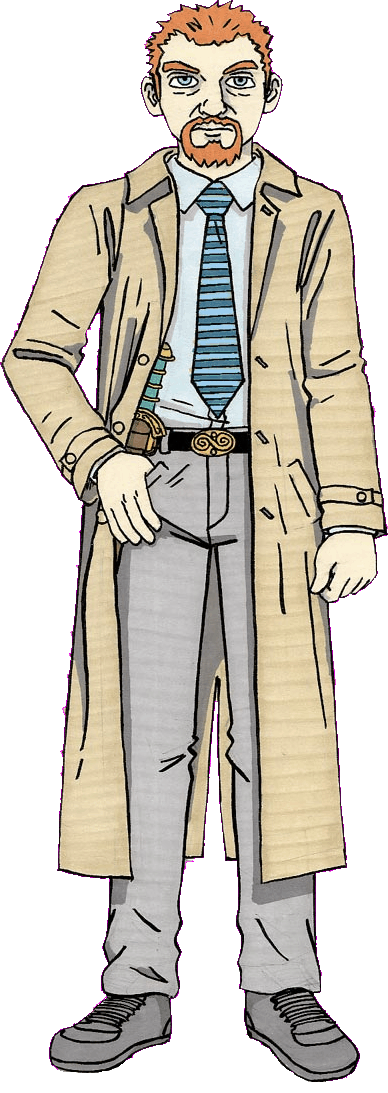
Conal O'Ainle (1156-1472) |
Sacrifices:
Born in the spring of 1156 in a village now lost to time, Conal spent
his childhood hearing of wars and the coming of the Normans.
The year prior to his birth, the English King Henry II had acquired a
Papal Bull authorizing England to invade Ireland, and by Conal's
tenth birthday, the treason of Leinster's erstwhile King Diarmait Mac
Murchada afforded Henry and his Templars the political excuse they
needed to declare war against High King Ruaidri Ua Conchobair.
Having made their name and holdings as Wild Geese, Conal's family
thrived during the internecine warfare that followed, for a while.
In 1181, in a single battle, Conal lost his father and older
brother. Now the head of his clan, Conal adopted his
brother-in-law as his heir, and collecting a band of reinforcements
marched out to take his place with his family's forces in the army of
the High King. For a while they were successful, but during an
indecisive battle in 1183, the Norman forces were unexpectedly
reinforced by Templars marching in from Ulster, and the Connachta
were routed.
Fleeing the slaughter, Conal led those of his men who survived a
cavalry charge toward a bilberry thicket near the edge of a small
forest, where he hoped to shake off pursuit. During their
flight, most of his men were picked off by the knights and a cadre of
footsoldiers that had joined the pursuit. Conal entered the
thicket pursued by the Norman swordsmen.
As he fled through the thick bushes as quietly as possible, he
encountered what he took to be a young girl gathering berries and
singing tunelessly. In his haste and concern for her, he swept
her up onto his shoulder much to her surprise. She bit and
kicked him repeatedly, causing him to fall and attracting the
attention of the searching soldiers. Just as he was sure they
would both be killed (and probably worse), however, they were both
transported elsewhere.
What had happened was the girl was actually a fairy named Petal
Oak. She had reduced both of them to her natural size of about
four inches (about 10cm), which, in the thick bramble, effectively
made them invisible. She led Conal away, and, having become
intrigued by him due to his nearly-suicidal heroism, she decided to
keep him for a while and enjoy him. Over what seemed to Conal
to be several days (but turned out to be several years) he and Petal
Oak made love several times and wandered the now-endless forest of
the bilberry bramble. Evemtually, however, Petal Oak began to
grow bored, and Conal became restless, wanting to return to his home
and see to his family.
Petal Oak had one more trick up her sleeve, one she'd been
considering since the moment she saved Conal from the Norman
footsoldiers. Taling advantage of Conal's inate sympathy, she
tearfully explained to him how desparately she wanted a child, but
that fairies, being immortal, were unable to bear children. As
expected Conal said he would help her if he could, and Petal Oak
confronted him with her plan. If he willingly gave up his
mortality, and she gave up much of her immortality, she believed, she
would bear the child she wanted, and even better (she added) it would
be his child, so she would have something of him when he eventually
left her.
Petal Oak had been working to excite him as she explained her plan,
so Conal quickly agreed. They made love again, and as they
reached climax together, Conal felt a slight tug, as if he was losing
something important. After, Conal reached out to Petal Oak to
hold her in sleep as they had lain so often before. She glanced
over her shoulder at him and said, "Oh. You're still
here. Right." And in a flash, Conal was alone, back
in the place where Petal Oak had caused him to fall.
Losing Home
Conal found his sword (which he had inherited from his dead father)
lying where it had fallen (being made mostly of iron, it was immune
to Petal Oak's power), but it was now dull and heavily covered in
rust. Remembering tales of Oisin, he is worried about how much
time has passed. Also he was naked.
Finding a rough stone, he sharpened his sword, and, cutting selected
branches, constructed a primitive bow and some arrows. Over the
next few days he hunted rabbits and squirrels in the woods and nearby
thicket to feed himself and to gather their furs for clothing.
Finally outfitted, he started west in search of civilization.
After a march of some miles, he finally arrived at a small farm.
Stopping at the well to get a drink of water, he was confronted by
the farmer and his daughter, who suspected he might be one of the
Fae, come to steal their cattle (or, the farmer suspected, his
daughter). It took some time, but he finally convinced them
that he was, neither Fae nor a madman, and they took him in.
Conal stayed with the pair for a long time, repaying their kindness
with hard work. From a tinker, he learned that his village had
been razed, but his sister and her husband had saved much of the clan
and moved them to a new home where they were once again thriving in
the wars that were blossoming between the Lords all over Eire.
It had been thirty years since the battle, and Conal decided to
settle in on the farm with the farmer and his daughter, Colleen (this
may not have been her actual name; "cailin" means
"girl" in Irish Gaelic, but it was all her father or Conal
ever called her). Eventually an understanding developed between
Conal and Colleen, and when a travelling friar passed through the
neighborhood, the imposed on him to sanctify their agreement.
They lived together for several happy but childless years.
When, at the end of her life, Colleen expressed wonder at his youth
and regret that she could never give him children, Conal finally told
her the whole storyof how he came to wander out of the woods that
day. She nodded and said, "Though we were married, I have
long suspected you had only one wife, and she wasn't me."
Then she died.
Conal built a cairn over her in the old fashion, then burned down the
farmhouse and released the sheep and cattle. Then he started
along the road to Dublin.
The Wild Goose:
For the next two centuries, Conal wandered Europe serving as a
mercenary in any army that would take him. He discovered early
on that he could not be easily killed, and learned to use that to his
advantage, faking his own death when he needed to leave a place and
start again elsewhere. During this period, he didn't bother to
change his name: records were spotty at best, and even if
someone recognized him, he could pretend to be one of his own
descendents or other relative, recursive naming being a popular custom.
In the 15th century, he found himself in England, serving the various
factions in the Wars of the Roses, when, during a victory feast after
a minor battle, he saw a face he remembered.
Petal Oak and Penelope:
It was Petal Oak, and, when she saw him, she was thrilled (for some
reason). She all but tackled him and pumped him for news of his
life. Having learned discretion through his 300-odd years of
immortality, he took her aside and spoke to her privately.
She explained that she had made two discoveries since their
parting: she was no longer bound to her bilberry thicket, and
she could be hurt. The first discovery thrilled her; the world
was huge and she was fascinated by every bit of it, especially human
beings and the way they interacted. The second discovery was
fun at first, but it got boring and then annoying; she decided she
didn't like it.
When he was finally able to turn the conversation to their child, she
was non-plussed. She had, it turned out, completely forgotten
that she was pregnant, and since fairies exercise more or less
complete control over their bodies, she had, effectively, frozen the
pregnancy in stasis for three hundred years.
Determined to have the child he had been denied with Colleen, Conal
arranged to "die" in the next battle and settle in the
country under a different name with Petal Oak and raise their
deferred family. |